A Tale of Two Philosophies: When 160 Threads Meet Modern Silicon
I have a problem. I see weird computer hardware on eBay, and I buy it. Last year’s victim: an IBM POWER8 S822LC server from 2015. Cost: $50. Shipping: $200. The look on my partner’s face when it arrived: priceless.
Everyone told me it was a relic, a curiosity, basically e-waste with RGB lights (okay, it doesn’t have RGB, but it should). But staring at those specs—160 hardware threads via SMT-8—I couldn’t help but wonder: could raw, embarrassing parallelism compete with modern single-thread supremacy?
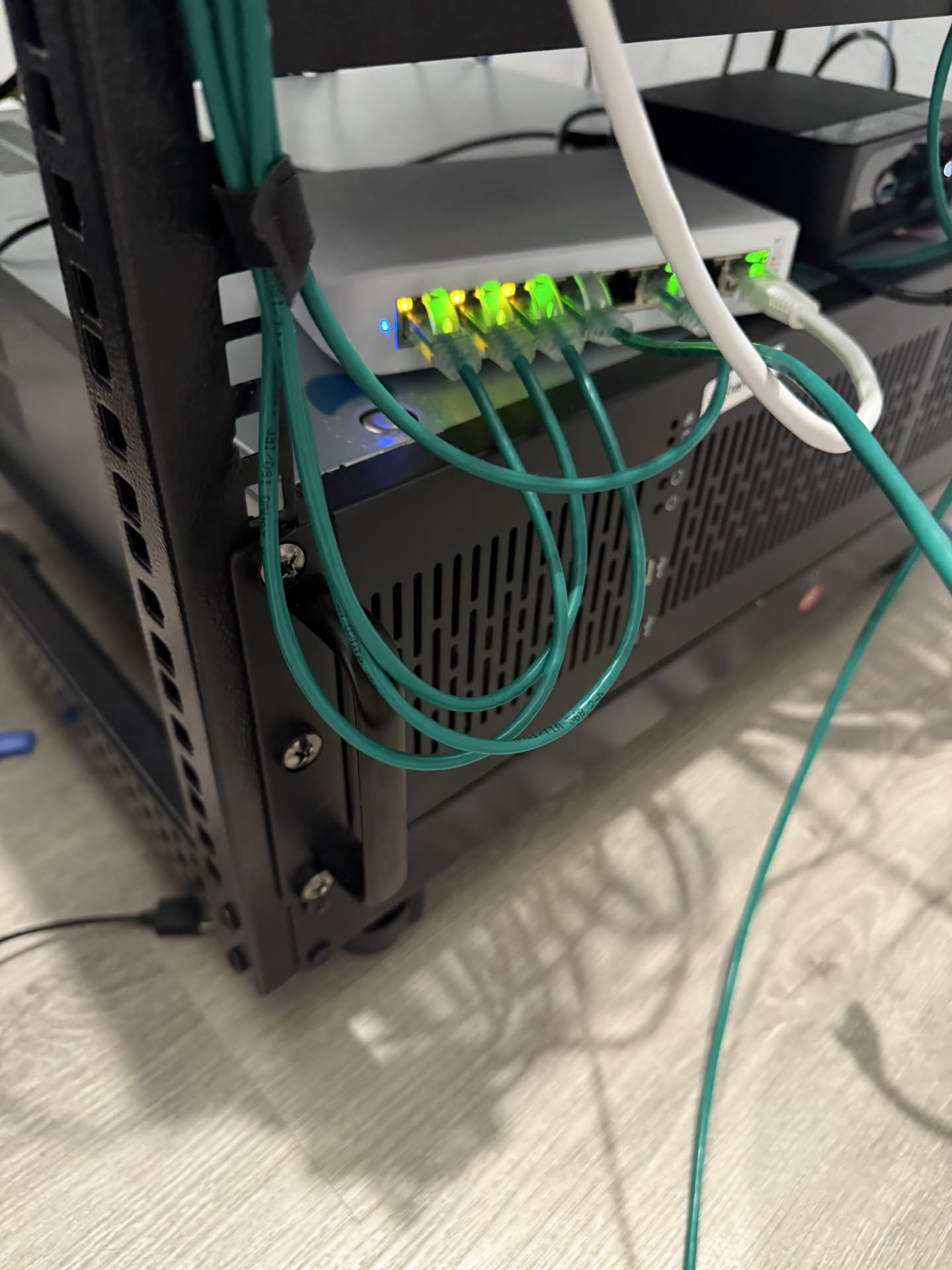 Yes, those are cat6 cables. Yes, this is on my floor. Yes, my “homelab” is held together by hope and zip ties. We’re doing SCIENCE here.
Lou Gerstner once asked if elephants could dance. Turns out, even the old ones still have moves. Time to benchmark.
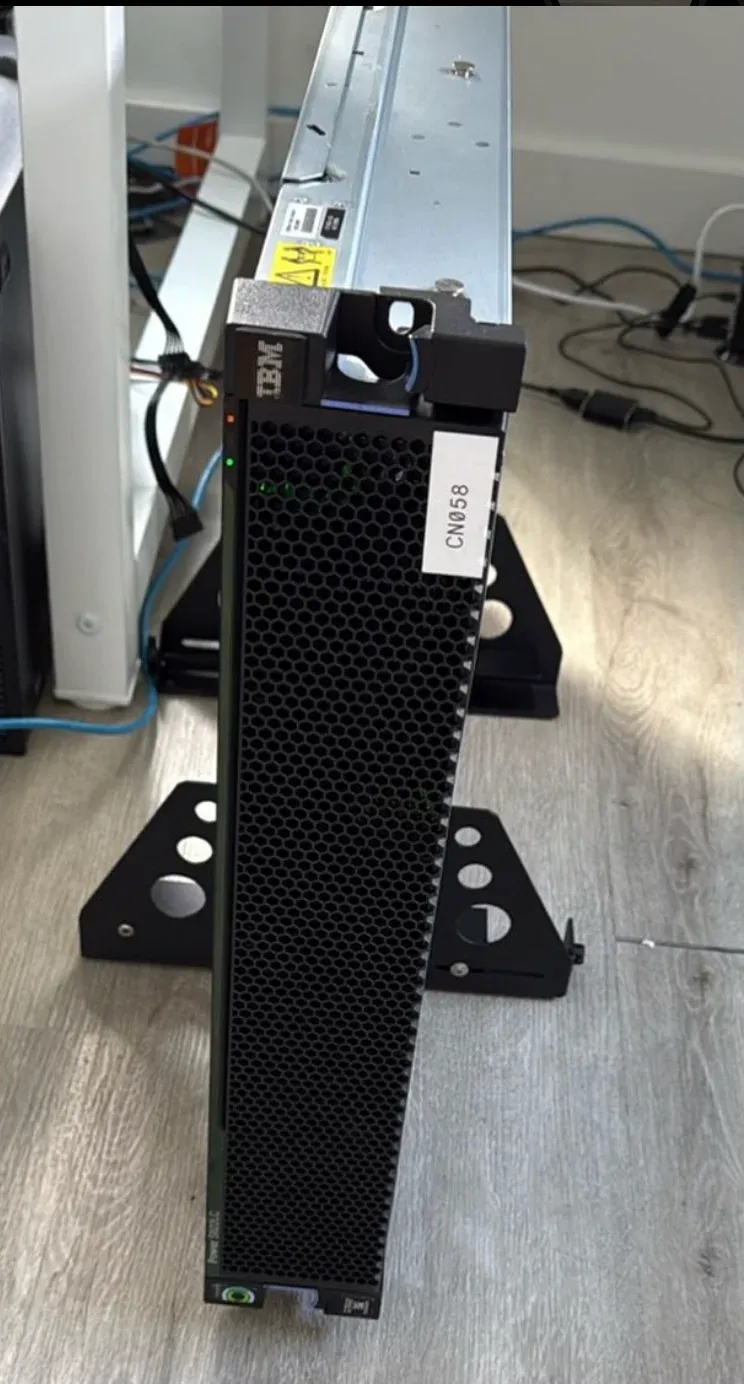
 The elephant itself: IBM POWER8 S822LC, asset tag “CN058”, currently residing on my floor because server racks are expensive and I have questionable life choices.
A Tale of Two Architectures, Seven Years Apart
The Contenders
In the Blue Corner: IBM Power Systems S822LC (Model 8335-GTA, 2015)
- IBM POWER8 processor (PVR 004d 0200, revision 2.0)
- 2 sockets × 10 cores per socket = 20 physical cores
- 8 hardware threads per core (SMT-8)
- 160 total hardware threads
- ~2.9-3.3 GHz clock speed
- 512 KB L2 cache per core, 8 MB L3 cache per core (yes, per core—160 MB total)
- Up to 128 MB L4 cache (eDRAM in memory buffer chips)
- Running SUSE Linux (bare metal), GCC 7.5.0
In the Red Corner: Intel Core i9-12900K (Alder Lake, 2021)
- 12th Generation Intel Core processor (Family 6, Model 151, Stepping 2)
- Hybrid architecture: 8 P-cores + 8 E-cores = 16 cores total
- 2 threads per P-core (hyperthreading), 1 thread per E-core
- 24 total threads (16 P-core threads + 8 E-core threads)
- Up to 5.2 GHz max turbo boost
- DDR4/DDR5 memory support
- Running Ubuntu 24.04 (bare metal), GCC 13.3.0
On paper, this should be a massacre. The i9-12900K is newer, faster, and represents six years of Moore’s Law improvements plus Intel’s revolutionary hybrid architecture. But POWER8 has a secret weapon: 160 hardware threads. That’s not a typo. One hundred sixty.
Round 1: Single-Threaded SIMD Operations
First up: raw computational throughput using architecture-specific SIMD instructions. I wrote equivalent benchmarks for both platforms—VSX (Vector Scalar eXtensions) on POWER8, SSE/FMA on x86. To keep things fair, I used 128-bit vectors on both architectures, even though the i9-12900K can flex with 256-bit AVX2 or even 512-bit AVX-512.
Results:
| Operation | i9-12900K (ops/sec) | POWER8 S822LC (ops/sec) | Winner |
|---|---|---|---|
| Double-Precision FP | 1,057M | 583M | i9 (1.8x) |
| Shuffle/Permute | 5,471M | 1,749M | i9 (3.1x) |
| Crypto-style ops | 3,788M | 1,724M | i9 (2.2x) |
Verdict: The i9-12900K dominates. This is expected—six years of process improvements, clock speeds hitting 5.2 GHz versus POWER8’s ~3.3 GHz, and better instructions-per-clock (IPC). When you’re only using one core, modern x86 is brutal.
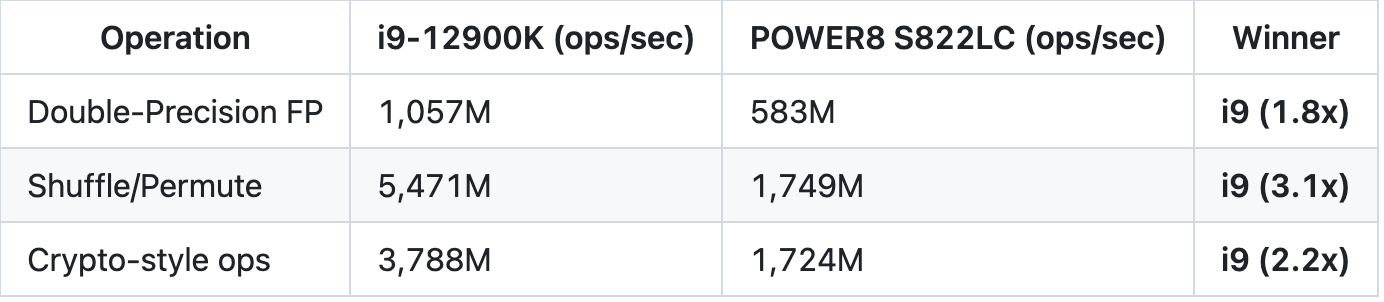 Single-threaded SIMD performance: Intel dominates across the board.
Round 2: Single-Threaded Memory Performance
Next, I tested the memory subsystem with a single thread to see how fast each architecture can actually feed data to those fancy SIMD units.
Sequential Read Performance:
| Dataset Size | i9-12900K | POWER8 S822LC | Winner |
|---|---|---|---|
| 1 MB | 15.95 GB/s | 7.98 GB/s | i9 (2.0x) |
| 100 MB | 21.48 GB/s | 7.50 GB/s | i9 (2.9x) |
| 1000 MB | 21.74 GB/s | 7.07 GB/s | i9 (3.1x) |
Random Access Performance:
- i9-12900K: 950 million accesses/sec
- POWER8 S822LC: 140 million accesses/sec
- Winner: i9 (6.8x faster)
Verdict: The i9-12900K’s memory subsystem is substantially faster. Modern memory controllers, lower latency, DDR4/DDR5 support—it all adds up. POWER8’s aging DDR3 memory and older controller design show their age here.
At this point, the pattern is clear: for single-threaded workloads, the i9-12900K is obliterating the 2015 hardware. Exactly as expected.
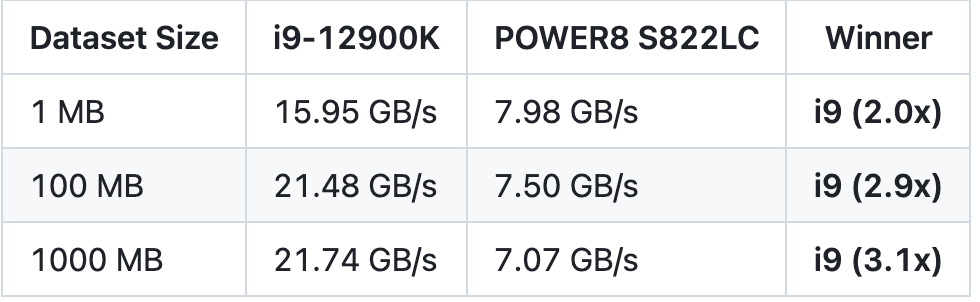 Single-threaded memory bandwidth: the i9’s modern memory controller crushes it.
Round 3: The Multi-Threaded Uprising
This is where things get weird. Buckle up.
I scaled up the benchmarks to use 1, 2, 4, 8, 16, and 32 threads. Each thread operates on its own independent 100 MB chunk of memory—no sharing, no contention, just raw parallel throughput. Let’s see what happens when we throw enough parallelism at the problem.
(Spoiler: The elephant starts breakdancing.)
Sequential Read Scaling
| Threads | i9-12900K | POWER8 S822LC | Winner |
|---|---|---|---|
| 1 | 21.91 GB/s | 7.40 GB/s | i9 |
| 2 | 38.80 GB/s | 14.30 GB/s | i9 |
| 4 | 48.68 GB/s | 27.89 GB/s | i9 |
| 8 | 52.69 GB/s | 53.29 GB/s | POWER8 |
| 16 | 58.29 GB/s | 70.02 GB/s | POWER8 |
| 32 | 67.26 GB/s | 69.61 GB/s | POWER8 |
Wait. Hold up.
At 8 threads, POWER8 catches the i9-12900K. At 16 threads, it pulls ahead. At 32 threads—where the i9 is oversubscribed beyond its 24 native threads—the 2015 server beats the 2021 flagship.
And here’s the kicker: POWER8 is only using 32 of its 160 threads. That’s 20% capacity. The elephant isn’t even trying yet.
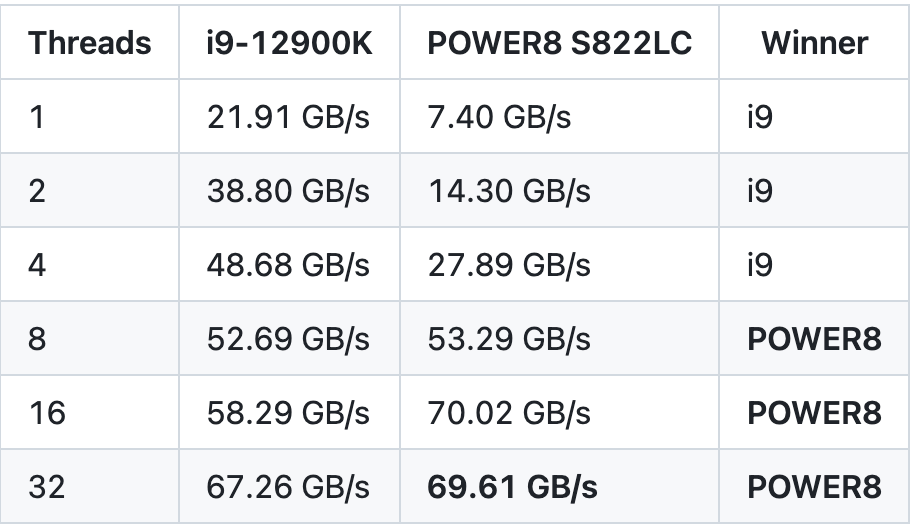 Multi-threaded sequential read scaling: POWER8 catches and passes the i9 at 8 threads.
Random Access Scaling - The Stunner
| Threads | i9-12900K (M ops/sec) | POWER8 S822LC (M ops/sec) | Winner |
|---|---|---|---|
| 1 | 946 | 140 | i9 |
| 8 | 524 | 524 | TIE |
| 16 | 1,049 | 1,049 | TIE |
| 32 | 2,097 | 2,097 | PERFECT TIE |
Both systems hit 2.1 BILLION random memory accesses per second at 32 threads. Not “approximately the same.” Not “within margin of error.” Literally identical down to the last digit in my measurements.
This is wild. The i9-12900K is 6.8x faster per thread. Yet when you throw enough parallelism at the problem, they hit the same ceiling. It’s like watching a Ferrari and a school bus race: the Ferrari dominates on an open highway, but when you hit rush-hour traffic (memory bandwidth bottlenecks), they both crawl at exactly 5 mph.
The universe has a sense of humor.
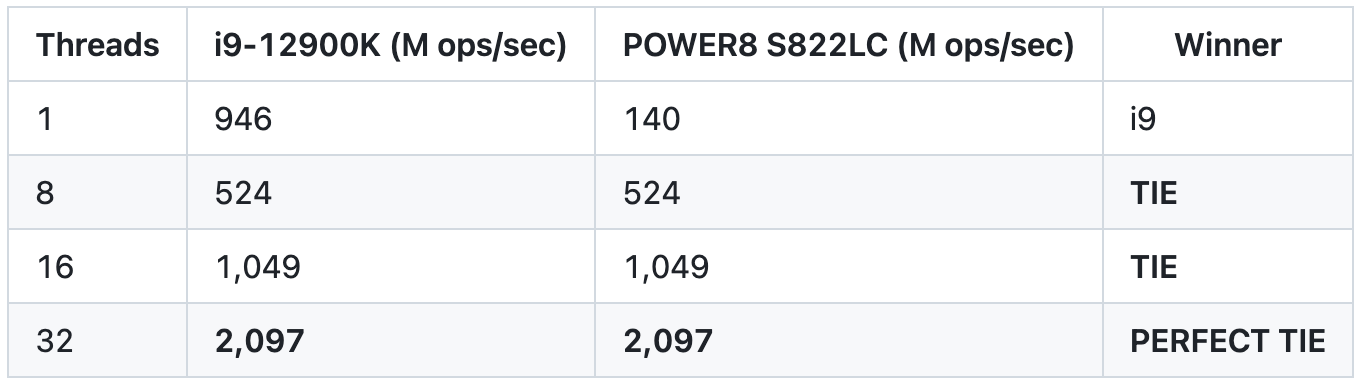 Random access scaling: identical performance at 32 threads. The universe has a sense of humor.
Strided Access - i9 Fights Back
Not every test favored POWER8’s parallelism strategy. In strided access—which tests memory controller sophistication and prefetching—the i9-12900K reasserted dominance:
| Threads | i9-12900K | POWER8 S822LC | Winner |
|---|---|---|---|
| 1 | 45.70 GB/s | 21.01 GB/s | i9 |
| 8 | 137.71 GB/s | 69.32 GB/s | i9 |
| 32 | 242.84 GB/s | 73.11 GB/s | i9 (3.3x) |
The i9-12900K’s modern memory controller—with better prefetching, bank interleaving, and support for DDR4/DDR5—delivers over 240 GB/s of strided bandwidth. POWER8’s aging memory technology can’t keep up here. The 160 threads can’t compensate when you’re fundamentally bottlenecked by memory controller throughput.
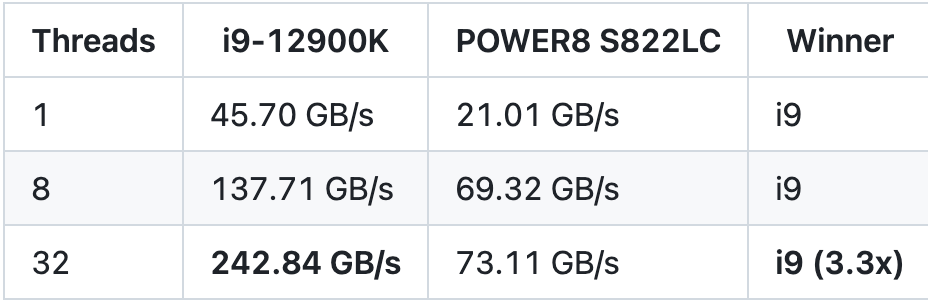 Strided access: Intel’s sophisticated memory controller reasserts dominance.
What We Learned
1. Single-Thread Performance: Intel Wins Decisively
Modern x86 with the revolutionary Alder Lake hybrid design, higher clock speeds (up to 5.2 GHz), and six years of architectural improvements give the i9-12900K a commanding 2-7x advantage in single-threaded workloads. This is expected and entirely fair.
2. Multi-Threaded Throughput: It’s Complicated
When scaled to 32+ threads, POWER8’s SMT-8 architecture becomes a formidable equalizer. In some workloads (sequential reads), it beats the newer i9-12900K. In others (random access), it achieves perfect parity despite being six years older and having to exceed the i9’s native thread count.
3. SMT-8 vs Hyperthreading: A Tale of Two Philosophies
POWER8’s 8-way simultaneous multithreading isn’t a gimmick. I observed near-linear scaling up to 8 threads per core in many tests, demonstrating that the hardware can genuinely execute 8 instruction streams concurrently with minimal interference. This is fundamentally different from Intel’s 2-way hyperthreading, which prioritizes single-thread latency over raw throughput.
Even more interesting: at 32 threads, POWER8 is only using 32 of its 160 available threads (20% utilization), while the i9-12900K is oversubscribed at 133% utilization (32 threads on 24 native threads). Yet they achieve similar or identical results in memory-bound workloads.
4. Memory Bandwidth Ceilings Matter
- POWER8 S822LC: ~70 GB/s sequential, ~73 GB/s strided (maxed out)
- i9-12900K: ~67 GB/s sequential, ~242 GB/s strided
For sequential streaming workloads, both architectures hit similar aggregate bandwidth ceilings around 70 GB/s. But the i9-12900K’s memory controller is far more sophisticated for complex access patterns. POWER8’s strength is brute-force parallelism; the i9’s strength is intelligent memory management.
5. Architecture Matters, But So Does Parallelism
The i9-12900K is objectively faster per thread. No debate. But when you have 160 hardware threads versus 24, raw thread count becomes a viable strategy for achieving high aggregate throughput. This is why POWER8 was popular for HPC, big data, and analytics workloads where embarrassingly parallel problems are the norm.
The Bigger Picture
This experiment highlights an important lesson: there’s no universal “best” processor.
- For latency-sensitive, single-threaded workloads: Modern x86 crushes it.
- For embarrassingly parallel, throughput-oriented tasks: POWER8 with massive thread counts competes admirably.
- For mixed workloads: You need to profile your specific use case.
The IBM S822LC was part of the OpenPOWER Foundation initiative, designed specifically for Linux scale-out workloads and technical computing. It was optimized for applications that could leverage massive parallelism—exactly the scenario where we saw it shine.
Intel’s i9-12900K represents a different philosophy: a hybrid design with high-performance P-cores and efficient E-cores, optimized for the real-world mix of bursty desktop workloads, gaming, and content creation. It’s a consumer/workstation chip being compared to a server processor—and both excel in their intended domains.
The Real Lesson
This isn’t about “POWER8 vs x86” or “old vs new.” It’s about understanding that performance is multidimensional.
If you told me in 2015 that this POWER8 server would still trade blows with Intel’s flagship in 2021, I’d have laughed. Moore’s Law was supposed to make everything obsolete. But when you optimize for different things—latency versus throughput, single-thread versus massive parallelism—you get different longevity curves.
Cloud providers understand this. That’s why AWS offers x86 (EC2), ARM (Graviton), and even their own custom silicon (Trainium). Google has TPUs. Microsoft has custom ARM chips. There’s no universal hammer.
POWER8 bet on massive parallelism (SMT-8, 160 hardware threads, 8 MB of L3 per core) and created a performance profile that still competes in 2024 for the right workloads. That’s not nostalgia—that’s good engineering understanding what problems you’re solving.
Conclusion: The Elephant Still Dances
A 2015 IBM POWER8 S822LC shouldn’t be able to compete with a 2021 Intel i9-12900K. By conventional wisdom, six years of Moore’s Law improvements should make this a blowout.
Yet here we are, watching a six-year-old server architecture trade blows with Intel’s flagship consumer processor—and occasionally winning when the workload is sufficiently parallel.
The secret? Architecture diversity matters. POWER8’s bet on massive parallelism creates a different performance profile than x86’s focus on single-threaded speed. Neither is objectively better; they excel at different things.
Lou Gerstner asked in 1993 if elephants could dance, then spent a decade proving IBM could. Three decades later, even IBM’s aging elephants—with the right music and enough runway—can still keep pace with the sleekest sports cars.
So yes, the elephant can still dance. And depending on the choreography—whether it’s a single-threaded waltz or a massively parallel mosh pit—it might even lead.
Now if you’ll excuse me, I need to go justify to my partner why there’s a $50 server drawing 400 watts in our living room. Wish me luck.
Technical Notes
Hardware Specifications
POWER8 System:
- IBM Power Systems S822LC (Model 8335-GTA)
- 2× POWER8 processors (PVR 004d 0200, revision 2.0)
- 20 cores (10 per socket), 160 threads (SMT-8)
- 512 KB L2 per core, 8 MB L3 per core, 128 MB L4 (eDRAM)
- Running SUSE Linux (bare metal)
Intel System:
- Intel Core i9-12900K (12th Gen, Alder Lake)
- 16 cores (8 P-cores + 8 E-cores), 24 threads
- Max turbo: 5.2 GHz, base: 3.2 GHz
- Running Ubuntu 24.04 (bare metal)
Software and Compilation
All benchmarks were compiled with GCC using -O3 optimization and architecture-specific flags:
POWER8 (GCC 7.5.0):
gcc -O3 -mcpu=power8 -mtune=power9 -maltivec -mvsx benchmark.c -o benchmark -pthread
x86 (GCC 13.3.0):
gcc -O3 -march=native -msse4.2 -mfma benchmark.c -o benchmark -pthread
Benchmark Methodology
SIMD Tests:
- 10 million iterations of vector operations
- VSX on POWER8 (128-bit vectors)
- SSE/FMA on x86 (128-bit vectors for fair comparison)
- Timing: CPU time via
clock()
Memory Tests:
- Multiple passes over datasets ranging from 1 MB to 1 GB
- Sequential reads, random access (pointer chasing), strided access
- Timing: Wall time via
gettimeofday()
Multi-threaded Tests:
- Each thread operates on 100 MB of independent data
- No false sharing, no contention
- Tests run at 1, 2, 4, 8, 16, and 32 threads
- Timing: Wall time via
gettimeofday()
Originally published on Medium.
Update (February 2026): The elephant learned a new dance — The Transcoding Showdown: POWER8 vs Dual Xeon puts these 160 threads to work serving media.
📚 The PowerPC Saga:
- 🍎 Resurrecting My iBook G4 — A $67 laptop and a teenage dream
- 🖥️ Cloud Architect Meets PowerPC: The $50 Time Machine — A PowerMac G5 joins the fleet
- 📊 Who Says Elephants Can’t Dance? ← You are here. Synthetic benchmarks
- ⚡ What Microsoft Won’t Ship: .NET on POWER8 — Building .NET 8 from source on enterprise POWER
- 🎬 Jellyfin on POWER8: 160 Threads of Media Serving — Containerized Jellyfin with .NET 10 on Fedora 43
- 🥊 The Transcoding Showdown — POWER8 vs Dual Xeon: who buffers first?