The Question Nobody Asked (But I’m Answering Anyway)
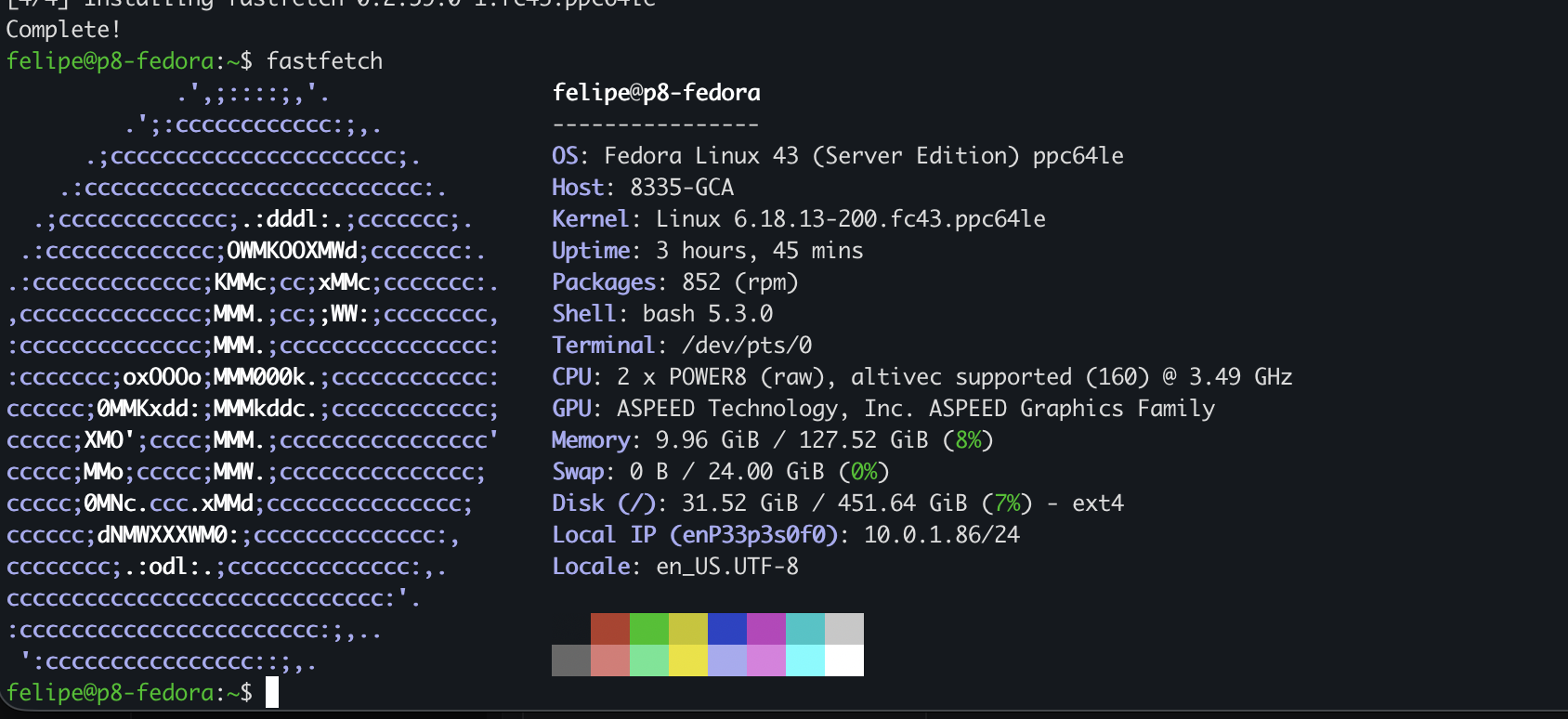
I have an IBM POWER8 server from 2014. It has 160 hardware threads. It draws 400W at idle. It sounds like a jet engine warming up. I compiled .NET 8 from source on it, then built Jellyfin 10.11 in nine increasingly desperate attempts, and now it’s streaming movies to my living room.
My wife thinks I have a problem. She’s correct. But that’s not the point.
The point is: last November I ran synthetic benchmarks — SIMD, memory bandwidth, thread scaling — and showed that POWER8’s massive parallelism compensates for lower single-thread performance. Cool, but abstract. Bench pressing in my garage.
Today I’m answering the real question: when my family sits down for movie night and four devices are transcoding simultaneously, which server actually keeps up?
The Fight Card
In the red corner, weighing in at 45 pounds and drawing enough power to heat a small apartment: the IBM POWER8 S822. Dual-socket, 160 threads of SMT8 fury, running Fedora 43 because I spent an entire afternoon fighting OPAL firmware over XFS boot partitions to install it.
In the blue corner, the reigning champion of my media stack: Dual Intel Xeon E5-2680 v4. 28 threads, AVX2, the kind of chip that libx264 was hand-tuned for in assembly over the past 20 years. Currently running my Jellyfin instance in Kubernetes like a responsible adult.
| 🔴 IBM POWER8 S822 | 🔵 Dual Xeon E5-2680 v4 | |
|---|---|---|
| Architecture | ppc64le | x86_64 |
| Cores / Threads | 20 / 160 (SMT8) | 14×2 / 28 (HT) |
| Clock | 3.49 GHz | 2.40 GHz |
| RAM | 128 GB DDR3 | 96 GB DDR4 |
| SIMD | AltiVec/VSX (128-bit) | SSE4.2/AVX2 (256-bit) |
| Year | 2014 | 2016 |
| What IBM designed it for | DB2 for Fortune 500 companies | … also DB2, honestly |
| What I’m using it for | Streaming Shrek to my Fire TV | Streaming Shrek to my Fire TV |
Methodology (or: How to Waste an Evening Scientifically)
Custom benchmark script (on GitHub) using ffmpeg directly. Same synthetic test files generated identically on each host using testsrc2 (1080p and 4K, 24fps). Three tests:
- Single stream: One transcode at a time. The “it’s just me watching a movie” test.
- Parallel streams: 1, 2, 4, 8 simultaneous transcodes. The “movie night” test.
- HEVC decode: 1080p HEVC → H.264. The “Fire TV can’t play this codec” test.
All CPU-only. No hardware acceleration on either machine. Pure silicon grudge match.
A Note About x264 and POWER
Before we begin — I can’t show ultrafast preset results for POWER8 because libx264 literally crashes on ppc64le with that preset:
x264_8_rc_analyse_slice: Assertion 'cost >= 0' failed
Aborted
This is a bug in x264’s rate control code on POWER — likely related to floating-point rounding differences or an assembly code path that assumes x86 semantics. x264 has been hand-tuned for x86 for two decades. The POWER code paths are… less battle-tested.
All POWER8 results use fast or slower presets. This matters — ultrafast is typically 2-3x faster than fast. Keep that in mind when comparing.
Round 1: Single Stream
The simplest case. You sit down, hit play on Jellyfin, your Fire TV demands a transcode. One stream. All cores. May the best architecture win.
1080p H.264 → H.264
| Target | Preset | 🔴 POWER8 | 🔵 Xeon | Winner |
|---|---|---|---|---|
| 1080p | fast | 1.71x | 2.97x | 🔵 by 1.7x |
| 1080p | medium | 1.47x | 2.58x | 🔵 by 1.8x |
| 1080p | slow | 1.18x | 1.15x | 🤝 Tied |
| 720p | fast | 3.02x | 4.45x | 🔵 by 1.5x |
| 720p | medium | 2.37x | 4.22x | 🔵 by 1.8x |
| 720p | slow | 1.86x | 2.50x | 🔵 by 1.3x |
| 480p | fast | 5.12x | 7.12x | 🔵 by 1.4x |
| 480p | medium | 4.26x | 6.75x | 🔵 by 1.6x |
| 480p | slow | 3.03x | 5.06x | 🔵 by 1.7x |
Speed shown as multiples of real-time. 1.0x = transcodes exactly as fast as the video plays. Above 1.0x = no buffering.
Intel sweeps Round 1. No surprise — this is like challenging a sushi chef to a sushi-making contest. libx264 has 20 years of x86 assembly optimization baked in. Every SSE register, every AVX2 lane, every branch prediction hint — hand-tuned by obsessive codec engineers.
But look at slow preset at 1080p: dead heat at ~1.15x. When the encoder has to think — more reference frames, subpixel motion estimation, trellis quantization — raw IPC matters less and POWER8’s wider superscalar pipeline starts to show. The gap narrows from 1.8x to essentially zero.
The good news: every result on both machines is above 1.0x real-time. Your movie plays without buffering on either server, at any quality setting, at any resolution. For single-viewer scenarios, both work fine.
1080p HEVC → H.264 (The “Fire TV Can’t Play This” Scenario)
Half the files in my library are HEVC. Fire TV chokes on them. Jellyfin has to decode HEVC and re-encode to H.264. This tests both decode AND encode.
| Target | Preset | 🔴 POWER8 | 🔵 Xeon | Gap |
|---|---|---|---|---|
| 1080p | fast | 2.39x | 2.92x | 🔵 by 1.2x |
| 1080p | medium | 1.91x | 2.52x | 🔵 by 1.3x |
| 720p | fast | 2.98x | 4.49x | 🔵 by 1.5x |
| 480p | fast | 3.92x | 7.15x | 🔵 by 1.8x |
Interesting — HEVC decoding narrows the gap at higher resolutions. At 1080p the Xeon is only 1.2x faster instead of 1.7x. HEVC is compute-heavy, and POWER8’s wider pipeline helps with the decode step. The bottleneck shifts from “how fast can you encode” to “how fast can you decode AND encode” — and POWER8 handles that pipeline better.
Round 1 verdict: Intel wins, but it’s not a knockout. Both machines serve a single client without breaking a sweat. The Xeon is faster by 1.3-1.8x depending on preset and resolution.
Round 2: Movie Night 🍿
Here’s where it gets real.
It’s Friday night. I’m watching a movie in the living room. Sara is watching a show in the bedroom. Sofia is watching Bluey on the iPad. A friend is streaming remotely because I made the mistake of sharing my server URL.
Four simultaneous transcodes. This is what media servers actually do. And this is where 160 threads start to matter.
Parallel Stream Scaling (1080p → 720p, fast preset)
| Streams | 🔴 P8 / stream | 🔴 P8 total | 🔵 Xeon / stream | 🔵 Xeon total | Winner |
|---|---|---|---|---|---|
| 1 | 3.63x | 3.63x | 4.49x | 4.49x | 🔵 |
| 2 | 2.65x | 5.30x | 3.37x | 6.74x | 🔵 |
| 4 | 1.92x | 7.70x | 1.79x | 7.17x | 🔴 POWER8 |
| 8 | 1.09x ✅ | 8.99x | 0.89x ❌ | 7.27x | 🔴 POWER8 |
Read that again. At 4 simultaneous streams, POWER8 overtakes the Xeon in total throughput.
And at 8 streams — the number that matters:
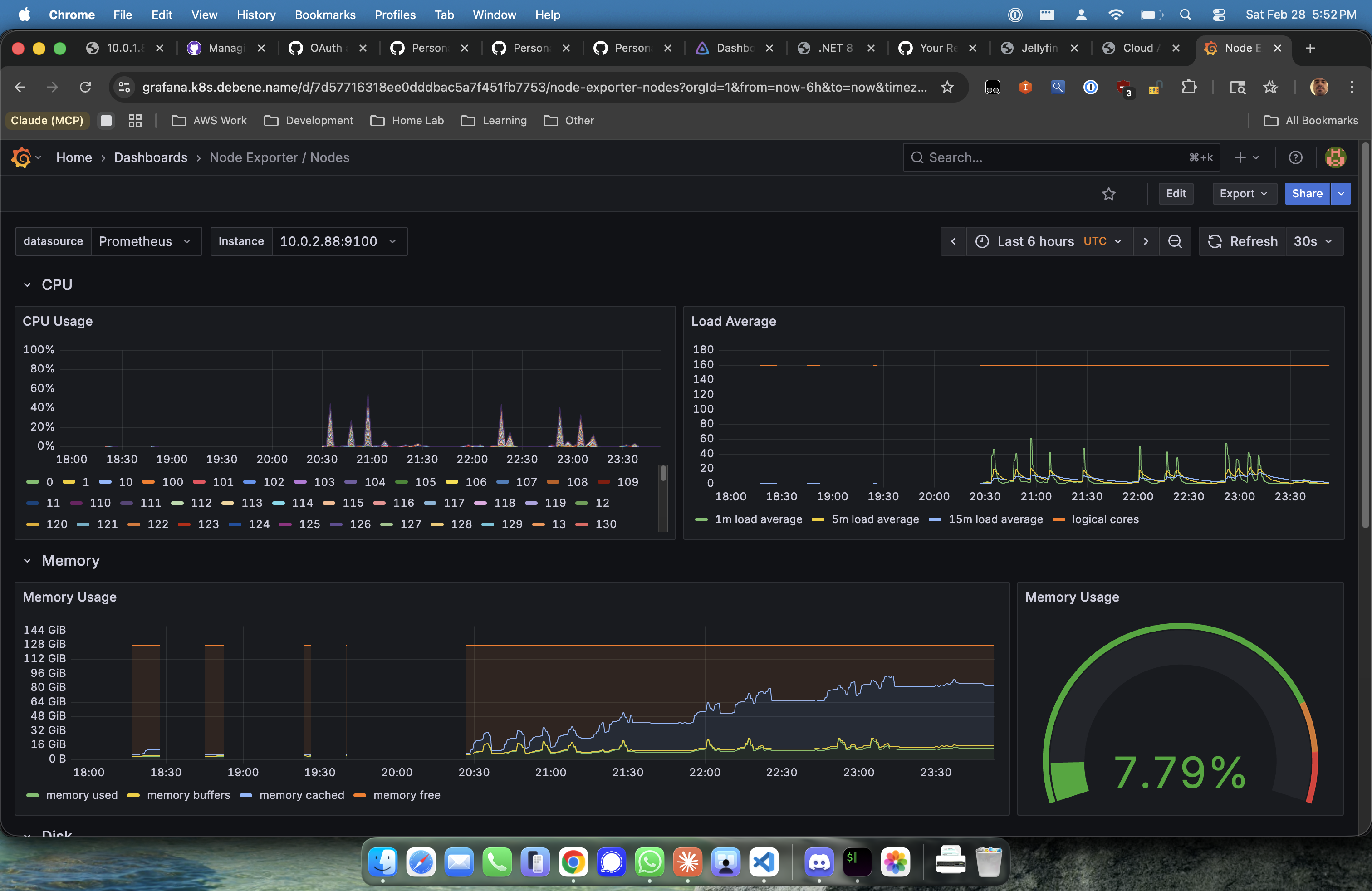
- POWER8: 1.09x per stream — every single client gets real-time playback. No buffering. No spinner. The elephant has 20 threads per stream and isn’t breaking a sweat.
- Xeon: 0.89x per stream — below real-time. Buffering. The pause that kills the mood. The reason your partner asks “why don’t we just use Netflix?” The Xeon has 3.5 threads per stream and they’re all maxed out.
The crossover happens at exactly 4 streams. Below that, Xeon’s per-thread performance wins. Above that, POWER8’s thread count dominates. The Xeon is a sprinter. The POWER8 is a marathon runner.
The Math
At 8 parallel streams:
- Xeon: 28 threads ÷ 8 streams = 3.5 threads per stream. At 100% utilization.
- POWER8: 160 threads ÷ 8 streams = 20 threads per stream. At 5% utilization per stream.
Extrapolating the scaling curve: the POWER8 could theoretically handle 12-16 simultaneous streams before any client drops below real-time. The Xeon tops out at 6-7.
Round 2 verdict: POWER8 wins decisively. The elephant dances when the dance floor gets crowded.
The Verdict
“The task of every generation is not to give in to the despair of the present but to find hope in the future.” — Lou Gerstner, Who Says Elephants Can’t Dance?
Lou was talking about saving IBM from bankruptcy in 2002. I’m talking about streaming movies from a server that was destined for a recycler. Same energy.
For 1-2 viewers: The Xeon wins. Faster per stream, optimized codecs, lower power draw. Use the right tool for the job.
For a household full of screens — kids, partners, guests, the friend who won’t stop mooching your Jellyfin — the POWER8 wins. It was designed for enterprise workloads with hundreds of concurrent connections. It just doesn’t know those connections are sending Frozen instead of SQL queries.
The elephant doesn’t sprint. It marches. And when everyone else is out of breath, it’s still going.
What I Learned
Thread count matters for parallel workloads. Obvious in retrospect, but it’s satisfying to prove with real data. SMT8 was designed for database connection handling — turns out media transcoding has the same pattern.
x86 codec optimization is decades ahead. libx264’s POWER assembly paths are an afterthought. If they got the same love as x86, single-stream numbers would be dramatically different. The
ultrafastcrash is just the most visible symptom.HEVC decode narrows the architecture gap. The more complex the codec pipeline, the less single-thread IPC matters. As media moves toward AV1 and VP9, POWER’s disadvantage in decode+encode scenarios may shrink further.
Power efficiency is a real argument for x86. The Xeon does 4-7 streams within real-time at ~150W TDP. The POWER8 does 8+ streams at ~400W. Per-watt, the Xeon is vastly more efficient. But I don’t pay for electricity by the transcode.
Alternative hardware is viable for media serving. Not optimal, not efficient, but viable. If you have a POWER8 sitting around (and who doesn’t?), it can absolutely run Jellyfin and serve your entire household.
What’s Next
The x264 ultrafast crash on ppc64le nags at me. If someone fixes that upstream, POWER8 single-stream numbers could jump 2-3x. I’m also curious about building ffmpeg with aggressive VSX/AltiVec optimizations — the Fedora package likely doesn’t target POWER8 specifically.
But for now, this 2014 IBM server is my media server. 22TB over NFS, Jellyfin in a container built from source and published to GHCR, transcoding for every device in the house.
Is it the most efficient way to stream media? Not even close. Is it the most fun? Without question.
Try It Yourself
Pull the container:
podman pull ghcr.io/felipedbene/jellyfin-power8:latest
Run the benchmark:
curl -O https://raw.githubusercontent.com/felipedbene/jellyfin-power8/main/transcode-bench.sh
chmod +x transcode-bench.sh && ./transcode-bench.sh
I dare you to find a machine with more threads. Hit me up — I want to see numbers from POWER9, s390x, RISC-V, whatever you’ve got.
📚 The PowerPC Saga
The complete journey from a $67 iBook to a $30,000 enterprise server:
- 🍎 Resurrecting My iBook G4 — A teenage dream fulfilled, two decades late
- 🖥️ Cloud Architect Meets PowerPC: The $50 Time Machine — A PowerMac G5 and the forgotten world of Big Endian
- 📊 Who Says Elephants Can’t Dance? — POWER8 vs i9-12900K: synthetic benchmarks
- ⚡ What Microsoft Won’t Ship: .NET on POWER8 — Building .NET 8 SDK from source. 6 hours, 7 patches.
- 🎬 Jellyfin on POWER8: 160 Threads of Media Serving — Nine build attempts and a working media server
- 🥊 The Transcoding Showdown ← You are here. The elephant dances when the floor gets crowded.
Benchmarked on an IBM S822 (8335-GCA) — Dual POWER8, 160 threads, 128GB RAM, Fedora 43, and an unreasonable amount of stubbornness.
— Felipe De Bene, Chicago, February 2026