
Here is the whole idea in one sentence: I control Spotify from a Mac OS 9 machine, over the Gopher protocol.
 This is a real System 9 desktop. The now-playing, the search, the queue — all of it is plain Gopher menus going to a box in my closet.
That screenshot is the fun part. The load-bearing part is duller and more useful, and it’s the reason a 2001 Power Mac and a 2024 Android phone can both talk to the same server without sharing a single line of code.
The seam: a frozen text API
A while back I put the live CTA ‘L’ trains on Gopher, and then that gopherhole grew a whole neighborhood — a phlog, a tarot reader, a shared Rust core. The trains taught me something I keep re-learning: Gopher’s constraint is the feature. A menu line is just type · label · selector · host · port. There is nowhere to hide a framework.
So when I wanted to drive Spotify from old machines, I didn’t build an app with an SDK. I built a machine-readable Gopher API — /spot/api/1 — and then I froze it. Ask for now-playing, get back a handful of key<TAB>value lines. Send a transport command as a selector. That’s the entire contract, and it’s written down as a client pattern in fhb so future-me can’t drift it.
The backend (gopher-spot) is a small Rust binary that geomyidae execs per connection. It holds the Spotify Connect session; audio flows separately as librespot → ffmpeg → Icecast, so the ancient clients just decode an MP3 stream. Credentials live in a chmod 600 file (or a Kubernetes Secret built straight from it) and never leave the box. The whole thing is LAN-only. No client ever sees a token.
The payoff: writing a new client is a weekend, not a project. There’s no OAuth, no SDK to port to a dead platform, no TLS stack to babysit. If your machine can open a TCP socket and read tab-separated text, it can be a Spotify remote.
The clients: four platforms, ~24 years apart
So I wrote four native Gopher clients. Three of them double as Spotify remotes — the radinhos — and each one is written the way its era wanted, not the way 2026 wants:
- Casquinha — Mac OS 9.2, plain C99, Open Transport for the socket,
minimp3decoding the stream in-app, classic Toolbox UI. The oldest machine yet. (the build diary) - DeGelato — Mac OS X 10.5 on a Power Mac G5 (PowerPC, 32-bit), Cocoa/Objective-C with no ARC and no blocks, GCC 4.2, CoreAudio on the Icecast stream.
- DeToca — Mac OS X 10.6 (Snow Leopard), Cocoa/Objective-C again, plus a 256-color ANSI/braille renderer for the rest of gopherspace.
- DeBurrow — the modern bookend: an Android Gopher client in Kotlin + Compose.
Here’s DeGelato on the G5, driving the player and browsing gopher.debene.dev (the CTA map is in that black window) at the same time:
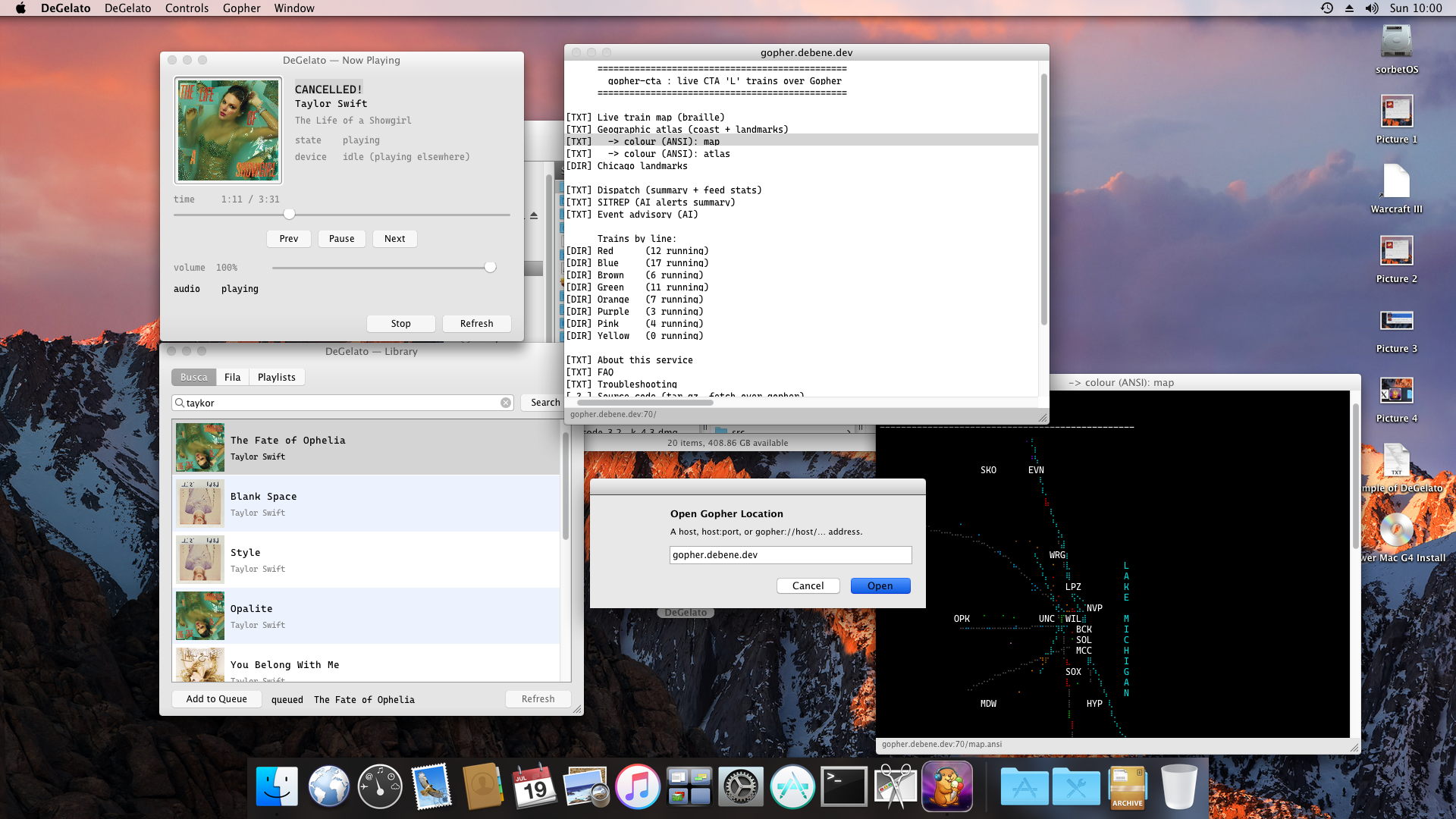 One backend, several windows: the same little server is serving now-playing to the player and menus to the browser.
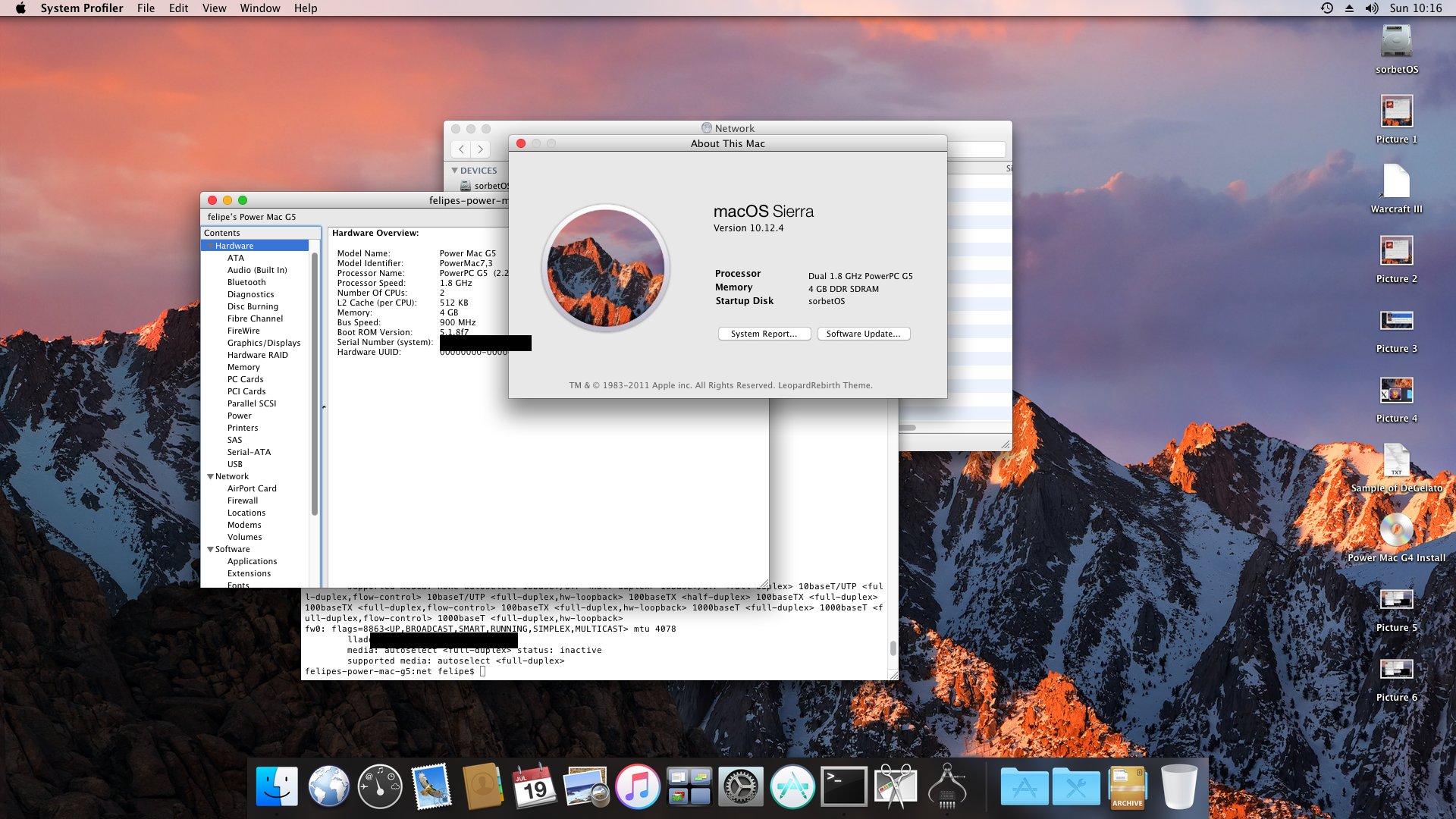
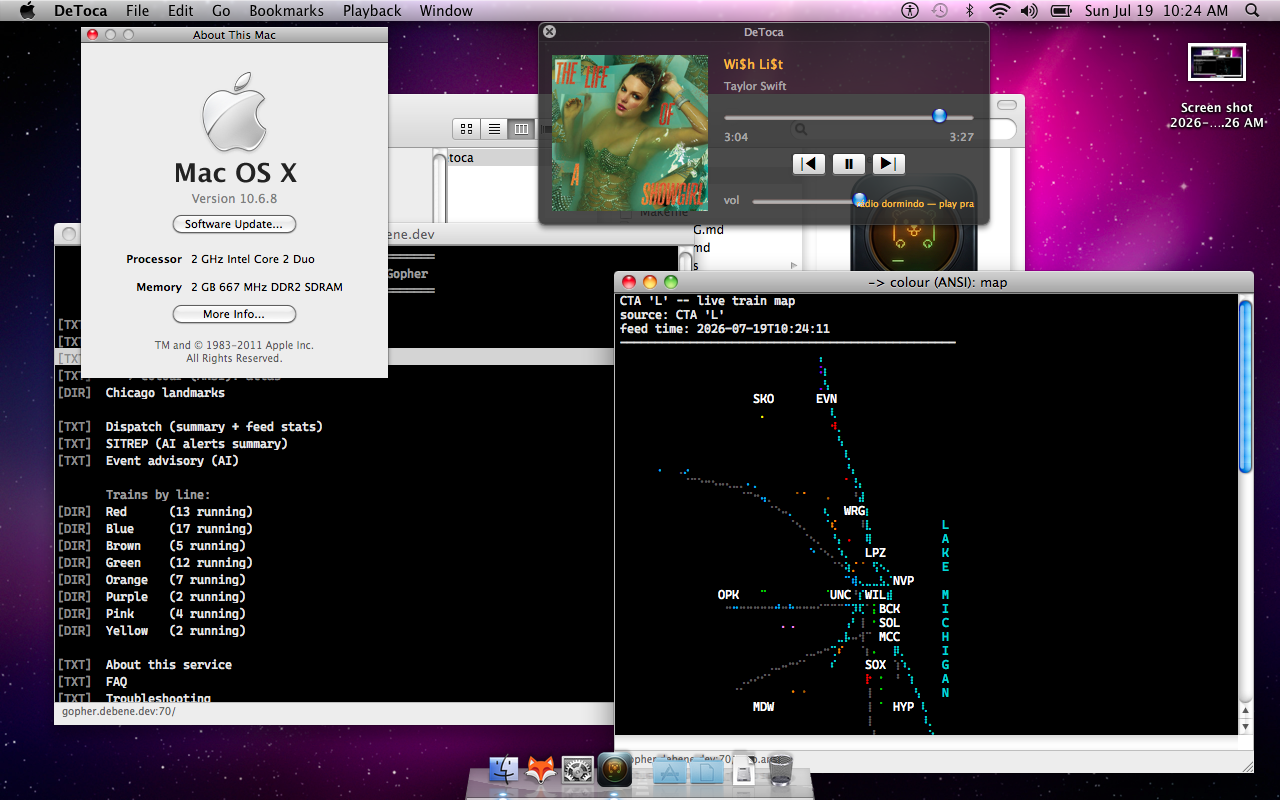
And because someone always asks “is that really running on the old hardware or is it a skinned VM?” — no, it’s the real thing. Left is a Power Mac G5 (Sorbet Leopard themed to look like Sierra); right is a MacBook2,1 on genuine 10.6.8:
The thing I find quietly satisfying: none of these clients know about each other, and the server doesn’t know about any of them. They agree on /spot/api/1 and nothing else. A protocol from 1991 turns out to be a great lingua franca precisely because it’s too dumb to have opinions.
The rest of the neighborhood
The Spotify bridge is one hole in a larger constellation, all on the same box, all cross-linked at the protocol level (a menu line on the front door just points at another port — no proxy, no ingress):
- gopher-cta — live Chicago ‘L’ trains as a Unicode-braille map.
- gopher-askthedeck — an interactive tarot reading drawn against the actual sky.
- gopher-blog — this blog, rendered to a phlog.
- gopher-core — the shared Rust spine underneath them.
Which sets up the kicker: you can read this exact post on Gopher. It flows through gopher-blog onto the phlog, so the write-up about a quiet protocol also lives on the quiet protocol —
gopher://gopher.debene.dev:7071
If you’ve got a Gopher client handy (or one of these four you can now build), point it there. If you don’t, that’s the whole pitch, really: the internet still has a volume knob, and it turns down further than you’d think.
Code’s all on GitHub — start with gopher-spot for the backend or fhb for the client pattern. Built in the open with Claude Code.