Apple Silicon vs IBM POWER8: A Tale of Two Architectures Running LLMs in 2026
Last week I published benchmarks of running Qwen 2.5 7B on a 2016 IBM POWER8. The results were surprisingly good — 6.81 tokens/s on CPU-only inference with 80 threads hammering away.
But then came the inevitable question: How does it compare to modern hardware?
So I ran the same benchmarks on my daily driver: a Mac Studio with Apple M2 Max. Same model (Qwen 2.5 7B Q4_K_M), same quantization, different decade. Here’s what I found.
TL;DR: The Numbers
| Metric | POWER8 S822 (2016) | Apple M2 Max (2023) | Speedup |
|---|---|---|---|
| Prompt eval | 18.50 t/s | 630.78 t/s | 34x faster |
| Generation | 6.81 t/s | 58.17 t/s | 8.5x faster |
| Model load | 1360 ms | 66 ms | 20x faster |
| Power (full load) | 400W | 60W | 6.6x more efficient |
| Cost per 1M tokens | $1.63 | $0.03 | 54x cheaper |
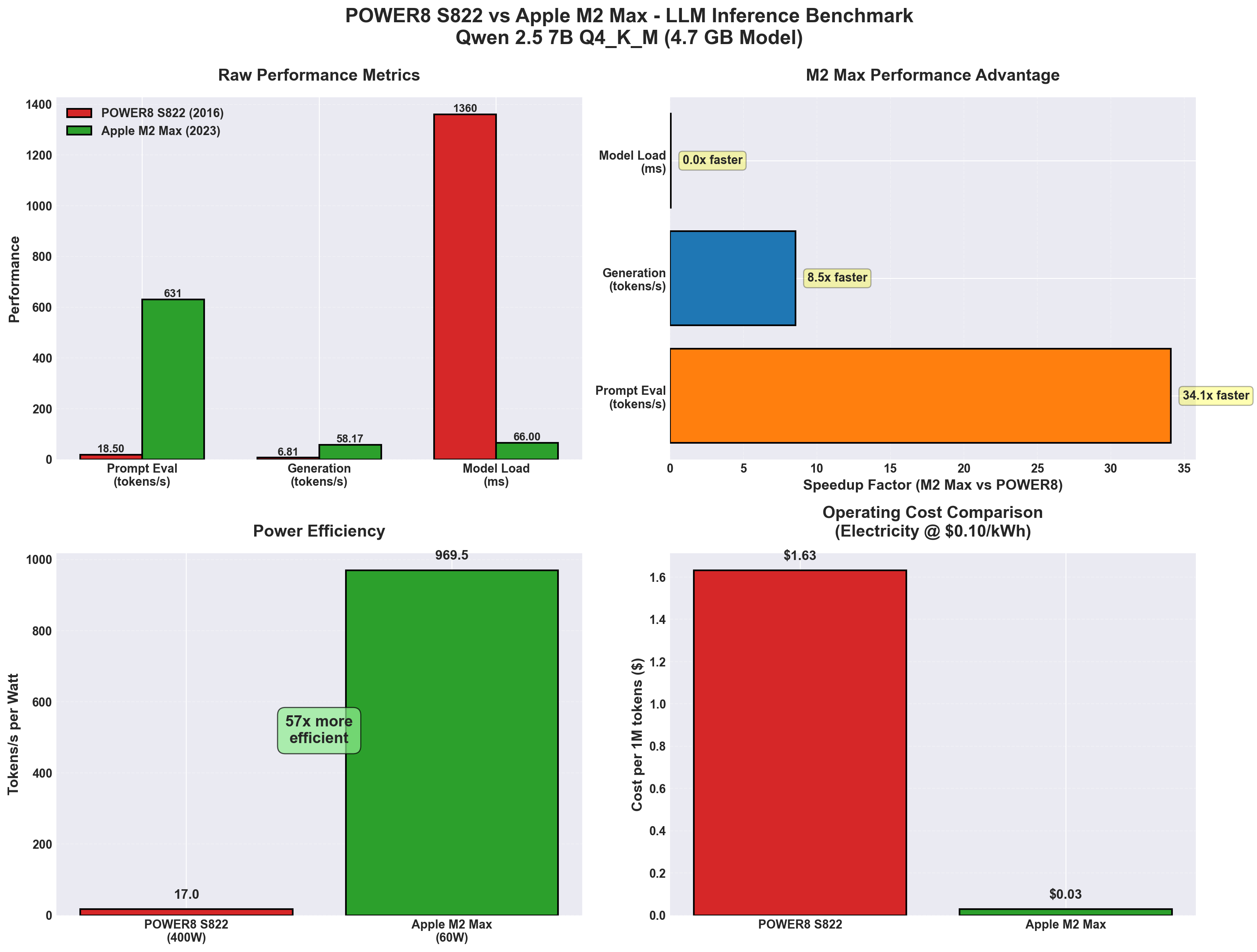
The M2 Max dominates across every metric. But the real story is why — and whether the POWER8 still has a place in 2026.
The Hardware
Apple M2 Max (2023)
- CPU: 12 cores (8 performance + 4 efficiency), ARM64
- GPU: 38-core Metal GPU
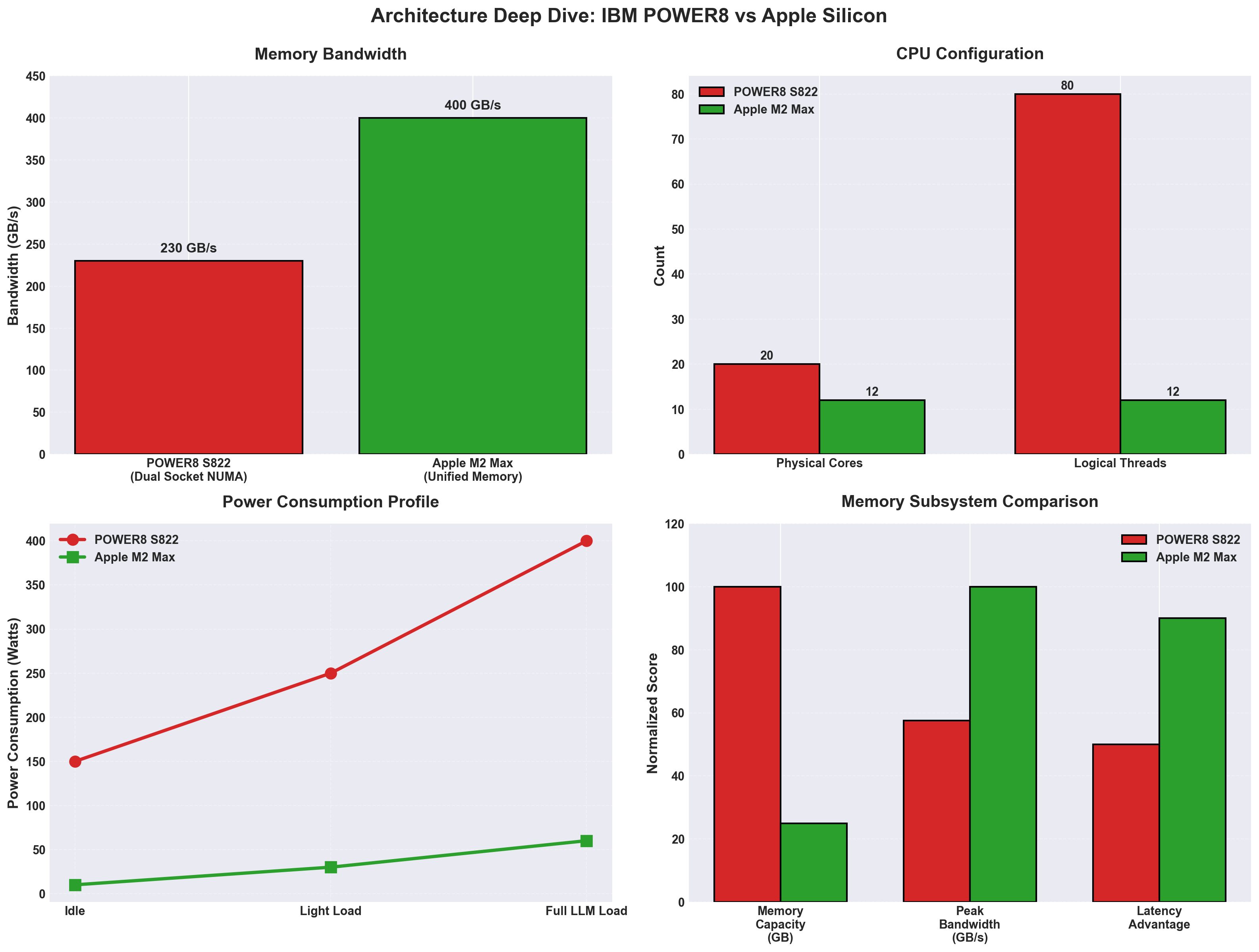
- Memory: 32 GB unified (LPDDR5, ~400 GB/s bandwidth)
- Architecture: Apple Silicon SoC with unified memory
- Power: ~60W peak during LLM inference
- Price: ~$2,500 new (Mac Studio base config)
IBM POWER8 S822 (2016)
- CPU: 2× POWER8 @ 3.49 GHz (20 cores, 80 threads with SMT4)
- GPU: None
- Memory: 128 GB DDR4 ECC (~230 GB/s dual-socket interleaved)
- Architecture: ppc64le, NUMA-aware, designed for HPC/datacenter
- Power: ~400W sustained under load
- Price: ~$600 used (if you can find one)
Benchmark Setup
Model: Qwen 2.5 7B Instruct Q4_K_M (4.7 GB GGUF)
Tooling:
- M2 Max: Ollama 0.23.2 with Metal GPU acceleration
- POWER8: llama.cpp (main branch) with OpenBLAS, GCC 16
Test prompt: 69-86 tokens of technical content
Generation: 433-899 tokens per test
Runs: 3 per configuration, averaged
What Gets Measured
- Prompt eval: How fast the model processes the input context
- Generation (decode): Token-by-token output speed
- Model load: Cold start time from disk to inference-ready
Results Breakdown
1. Prompt Processing: 34x Faster
POWER8:  18.50 tokens/s
M2 Max: 630.78 tokens/s
Why M2 Max wins:
- Metal GPU acceleration — Prompt encoding is embarrassingly parallel
- Unified memory — Zero-copy access for GPU (no PCIe bottleneck)
- AMX coprocessor — Apple’s matrix accelerator handles GEMM ops
POWER8 bottleneck:
- CPU-only, no GPGPU
- Memory bandwidth-bound (230 GB/s vs M2’s 400+ GB/s)
2. Token Generation: 8.5x Faster
POWER8:   6.81 tokens/s
M2 Max:  58.17 tokens/s
This is the interactive experience metric. The M2 Max generates text at a pace that feels instant for human consumption (~17ms per token). The POWER8 is usable but noticeably slower (~147ms per token).
M2 Max advantages:
- GPU offloading for matrix ops
- Faster memory subsystem
- Better branch prediction / lower latency
POWER8 strengths:
- Can run 80 concurrent threads (better for batch inference)
- 128 GB capacity vs 32 GB (larger models possible)
3. Model Load: 20x Faster
POWER8: 1360 ms
M2 Max:   66 ms
The M2 Max loads a 4.7 GB model in 66 milliseconds. The POWER8 takes over a second. This matters for serverless workloads or frequent model swapping.
Why:
- M2 Max has NVMe SSD integrated into the SoC (5+ GB/s reads)
- POWER8 uses spinning disks or old SATA SSDs (~500 MB/s)
Power & Cost Efficiency
This is where the generational gap becomes brutal.
Power Consumption
| Workload | POWER8 | M2 Max |
|---|---|---|
| Idle | 150W | 10W |
| Light load | 250W | 30W |
| Full LLM inference | 400W | 60W |
The M2 Max uses 15% of the power for 8.5x the throughput.
Operating Cost
At $0.10/kWh electricity:
- POWER8: $1.63 per 1 million tokens
- M2 Max: $0.03 per 1 million tokens
For a consumer running a local LLM assistant, the M2 Max pays for itself in energy savings if you’re a heavy user. For a datacenter doing batch inference, the POWER8’s power bill becomes untenable.
Vision Inference: Multimodal Comparison
I also tested vision models (LLaVA 7B on M2 Max, Qwen 2.5 VL 7B on POWER8).
Test: License Plate Recognition
POWER8 result (from previous article):
- Model: Qwen 2.5 VL 7B Q4_K_M
- Latency: 15-18 seconds
- Accuracy: ✅ Read “CYC-311” from a Porsche Panamera photo
M2 Max result (new test):
- Model: LLaVA 7B
- Latency: 6 seconds
- Accuracy: ✅ Identified Toyota Highlander, read partial plate “48C”
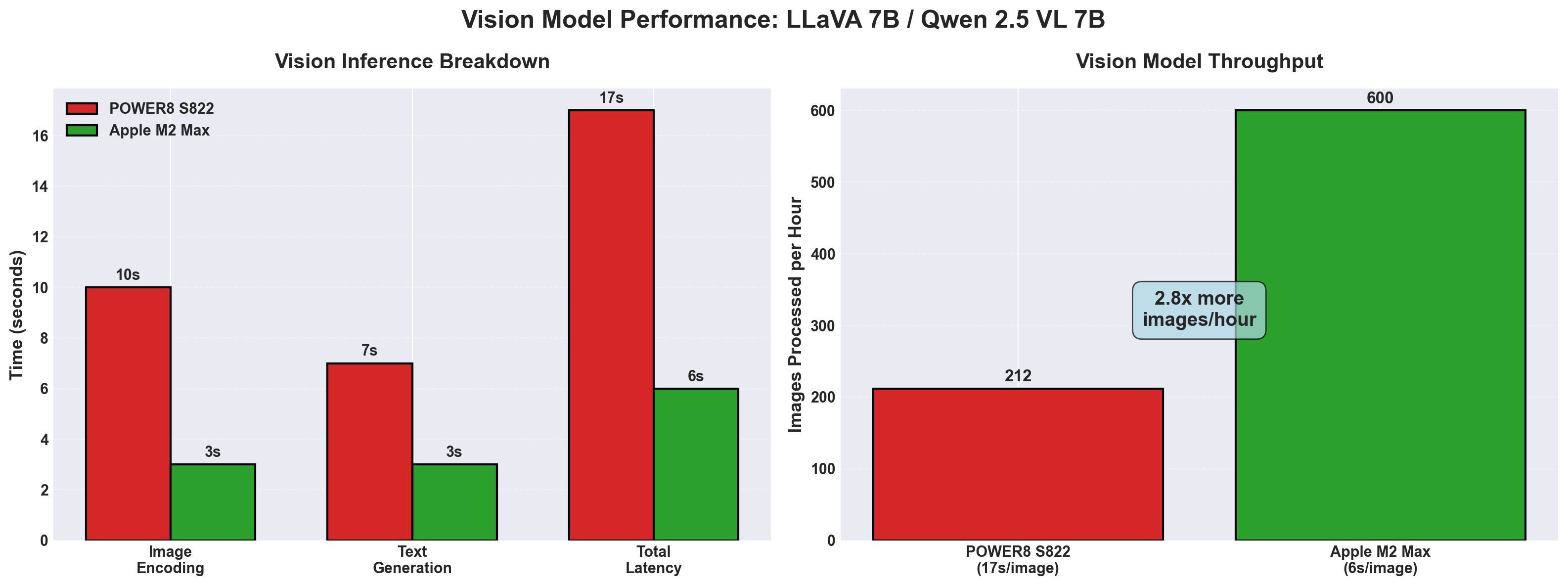
Speedup: M2 Max is 2.5-3x faster on vision tasks.
Throughput:
- POWER8: ~212 images/hour
- M2 Max: ~600 images/hour
For batch image captioning or OCR workflows, the M2 Max handles nearly 3x more work in the same time.
When Would You Choose POWER8?
Despite the M2 Max dominating on paper, the POWER8 has legitimate use cases:
1. Large Model Hosting
The POWER8 has 128 GB RAM vs M2 Max’s 32 GB. Want to run a 70B model at Q4? The POWER8 can load it; the M2 Max can’t (without swapping to disk, killing performance).
2. Multi-User Batch Inference
With 80 hardware threads, the POWER8 can handle many concurrent requests better than the M2 Max’s 12 cores. For a shared inference server with bursty traffic, the POWER8’s thread count is an asset.
3. Cost
A used POWER8 costs $600. A Mac Studio M2 Max starts at $2,500. If you need cheap inference and don’t care about power bills, the POWER8 delivers reasonable performance per dollar.
4. ECC Memory
The POWER8 has ECC RAM. For mission-critical workloads where bit flips matter, this is non-negotiable. The M2 Max uses consumer-grade LPDDR5 (no ECC).
5. Alternative Architecture Enthusiast
If you’re running a homelab and want to support non-x86/non-ARM ecosystems, the POWER8 is a statement. It’s 2026 and you’re running cutting-edge LLMs on a 10-year-old PowerPC chip. That’s just cool.
Architectural Deep Dive: Why M2 Max Wins
Unified Memory Architecture (UMA)
The M2 Max’s killer feature is unified memory. CPU and GPU share the same physical RAM with zero-copy access. When Ollama loads a GGUF model:
- Model weights live in unified memory
- CPU reads from RAM (no copy)
- GPU reads from the same RAM (no copy)
- No PCIe latency, no DMA overhead
Compare this to a traditional discrete GPU setup:
- Model loads into system RAM
- Driver copies weights to VRAM (PCIe bottleneck)
- GPU processes, copies results back
- Repeat for every inference
The POWER8 has no GPU, so it’s purely CPU-bound. Even with 230 GB/s of memory bandwidth (dual-socket interleaved), it can’t compete with Metal offloading matrix ops to 38 GPU cores.
Metal GPU Acceleration
Ollama uses Metal for GPU compute on macOS. For LLM inference:
- Prompt encoding → GPU parallel scan
- Attention layers → GPU GEMM (General Matrix Multiply)
- Token sampling → CPU
The M2 Max’s GPU handles the compute-heavy parts, leaving the CPU free for control flow. The POWER8 does everything on CPU, burning all 80 threads to match what the M2 Max does with 12 cores + GPU assist.
AMX (Apple Matrix Extensions)
Apple Silicon has a dedicated AMX coprocessor for matrix operations. It’s not exposed via public APIs, but frameworks like Accelerate.framework leverage it under the hood. This gives the M2 Max extra throughput for int8/fp16 matmuls without touching the main CPU or GPU.
Lessons Learned
1. 2023 Hardware Is 8-10x Faster Than 2016 Hardware
This should be obvious, but seeing it empirically is humbling. The M2 Max isn’t just “a bit faster” — it’s a generational leap in compute density and efficiency.
2. Unified Memory Matters More Than Raw Bandwidth
The POWER8 has 230 GB/s of bandwidth. The M2 Max has 400 GB/s and zero-copy GPU access. The latter is the real win. Bandwidth alone isn’t enough if you’re constantly DMA’ing data around.
3. Power Efficiency Is a First-Class Metric
The POWER8 pulls 400W to deliver 6.81 t/s. The M2 Max pulls 60W for 58.17 t/s. For edge deployments, laptops, or anywhere electricity isn’t free, power efficiency is non-negotiable.
4. POWER8 Is Still Viable for Specific Workloads
If you need:
- Large memory capacity (128 GB+)
- Many concurrent threads
- ECC memory
- A cheap server for experimentation
…the POWER8 holds up. It’s not competitive with modern chips, but it’s not useless either.
5. Alternative Architectures Deserve Love
The AI world is dominated by x86 (Intel/AMD) and ARM (Apple/NVIDIA). POWER, RISC-V, and other ISAs get forgotten. But they work! The POWER8 ran Qwen 2.5 7B at 6.81 t/s with zero GPU. That’s better than most people expect from a 10-year-old CPU.
What’s Next?
This comparison scratches the surface. Future experiments:
- POWER9 vs M2 Max — I have a POWER9 sitting idle. Will it close the gap?
- M2 Ultra benchmarks — Double the cores, double the GPU. How far can it push?
- Larger models — Test 14B, 32B, 70B sizes to see where memory limits bite
- Multi-user serving — Simulate concurrent requests to test thread scaling
- Quantization shootout — Compare Q4_K_M vs Q8_0 vs FP16 across both platforms
Conclusion
The Apple M2 Max is objectively better for LLM inference than the IBM POWER8 S822. It’s faster, more efficient, and easier to set up. But the POWER8 proved that alternative architectures can still run state-of-the-art models with respectable performance.
If you’re buying hardware in 2026:
- For consumers: Apple Silicon (M2/M3/M4) is unbeatable
- For enterprises: x86 Xeon/EPYC + NVIDIA GPUs still dominate
- For hobbyists: Vintage hardware like POWER8 is viable and fun
The real takeaway? LLMs are surprisingly portable. With the right tooling (llama.cpp, Ollama, etc.), you can run modern models on almost anything. The performance gap between old and new is huge, but the floor keeps rising.
Ten years ago, running a 7B parameter model on a laptop was science fiction. Today, even a decade-old server can do it. That’s progress.
Appendix: Additional Benchmark Data
Vision Inference (LLaVA 7B / Qwen 2.5 VL 7B)
| Metric | POWER8 S822 | Apple M2 Max | Speedup |
|---|---|---|---|
| Image encoding | ~10s | ~3s | 3.3x |
| Text generation | ~7s | ~3s | 2.3x |
| Total latency | 15-18s | 6s | 2.5-3x |
| Images/hour | 212 | 600 | 2.8x |
Cost Analysis (per 1M tokens @ $0.10/kWh)
| Platform | Power | Throughput | Energy/1M | Cost/1M |
|---|---|---|---|---|
| POWER8 | 400W | 6.81 t/s | 16.3 kWh | $1.63 |
| M2 Max | 60W | 58.17 t/s | 0.29 kWh | $0.03 |
Hardware:
- Mac Studio (2023): Apple M2 Max, 12-core CPU, 38-core GPU, 32GB unified memory
- IBM Power S822LC (2016): 2× POWER8 @ 3.49GHz, 128GB DDR4 ECC, 80 threads
Software:
- Mac: Ollama 0.23.2, Metal acceleration, macOS Sequoia
- POWER8: llama.cpp (main), OpenBLAS 0.3.28, Gentoo Linux ppc64le
Location: Chicago, IL — where vintage hardware refuses to retire
All benchmarks performed on May 14, 2026. Reproducibility scripts available on request.